

Free shipping across Canada on orders over $200 CADShop Now
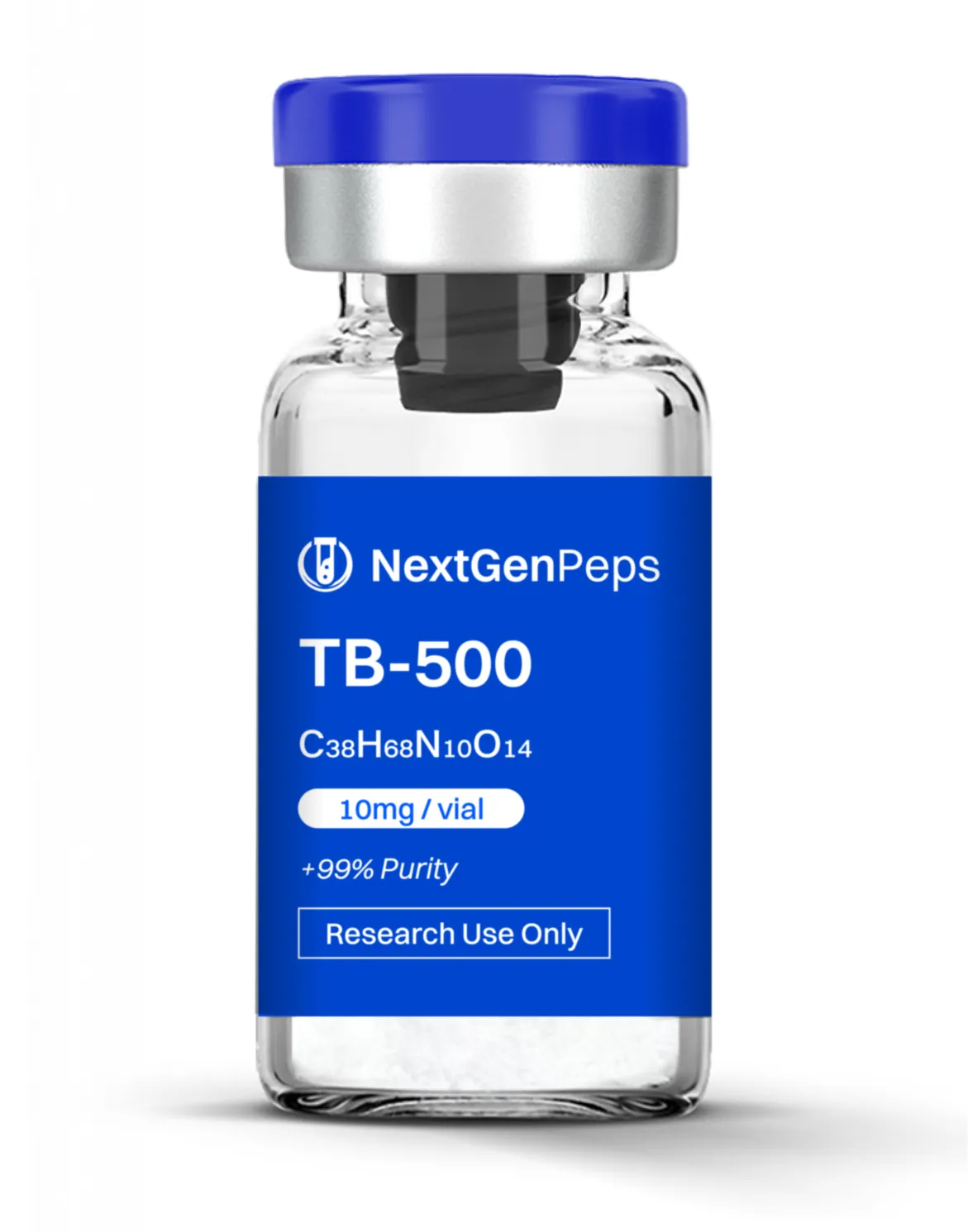
Next Gen Peptides TB-500 product image 1

Size:

Price:

$100.08

Out of Stock

Enter your email and we'll notify you when this item is back in stock.

Bulk Options:

Visa
Mastercard
American Express
Discover
PayPal
Venmo
Apple Pay

Similar Products

Product information

Lab results

TB‐500 Fragment (17‐23), also known as fequesetide, is a high‐purity, research-grade heptapeptide derived from the active domain of thymosin beta‐4 (TB4), engineered to model actin regulation, cell migration, and tissue repair in controlled experimental systems. This fragment represents the minimal TB4 sequence that retains the parent protein’s core binding and cytoskeletal effects while improving stability and bioavailability.

Molecular Composition and Mechanistic Profile

  • Mechanistically, TB‐500 Fragment (17‐23):

  • Binds directly to actin, modulating the balance between monomeric G‐actin and filamentous F‐actin and thereby influencing cell structure, motility, and replication.

  • Functions as a short, cell‐penetrating peptide capable of crossing cell and even nuclear membranes, which supports efficient intracellular and intranuclear access in vitro and in vivo.

  • Modulates signaling pathways such as Akt and Bcl‐XL, which are involved in cell survival, anti‐apoptotic responses, and tissue recovery.

    Compared with full‐length TB‐500, the fragment shares the same peptide sequence (LKKTETQ) but lacks an aldehyde group on the leucine residue, a difference that reduces its molecular weight (889.0 vs 846.97 g/mol) and is proposed to increase stability, prolong half‐life, and reduce off‐target interactions.

Integrated Research Applications

TB‐500 Fragment (17‐23) is employed to dissect TB4‐related repair mechanisms with a more focused, fragment‐based tool. Representative research domains include:

  • Wound healing and soft‐tissue repair: Animal models show accelerated wound closure, reduced inflammation, enhanced blood vessel growth (angiogenesis), and decreased scar formation, driven in part by fibroblast migration and cytoskeletal reorganization.

  • Muscle injury and regeneration: In muscle‐damage models, TB‐500 Fragment (17‐23) activates satellite cells, promotes their proliferation, and supports regeneration of damaged myofibers, likely via Akt‐mediated signaling and enhanced cell motility.

  • Musculoskeletal function and performance: Studies suggest improvements in musculoskeletal recovery and performance metrics by accelerating repair of micro‐injury from training and supporting structural integrity of muscle and connective tissues.

  • Neuroinflammation and CNS repair: TB4’s benefits in the brain, such as support for remyelination and neuroprotection, appear to be mediated through the same active domain represented by TB‐500 Fragment (17‐23), suggesting similar potential roles in CNS repair models.

  • Autoimmune demyelinating disease models (e.g., MS): By dampening inflammatory processes involved in myelin damage, TB‐500 Fragment (17‐23) has been proposed as a tool to study prevention of demyelination and relapse dynamics in multiple sclerosis–like models.

These actin‐modulating capacity to explore both local and systemic tissue repair mechanisms.

applications leverage the fragment’s small size, membrane permeability, and

Analytical Validation and Quality Features

TB‐500 Fragment (17‐23) is supplied by research vendors as a lyophilized powder at defined peptide content per vial (e.g., 10 mg). Typical analytical and manufacturing specifications include:

Purity: ≥99% as confirmed by high-performance liquid chromatography (HPLC) and/or mass spectrometry (MS).

Identity: Verified via MS and peptide sequencing to confirm the LKKTETQ heptapeptide structure and correct molecular weight.

Manufacturing standards: Often produced in ISO 9001 and cGMP‐audited facilities, with certificates of analysis (COAs) available on request.

These controls support batch‐to‐batch consistency, enabling reliable comparison of results across studies and laboratories.

Storage and Stability Guidelines

Although exact storage instructions can vary by supplier, standard peptide handling practices apply to TB‐500 Fragment (17‐23).

Lyophilized peptide: Store in a cool, dry place, protected from light, typically at refrigerated or frozen temperatures (e.g., ≤ −20 °C) for long‐term stability.
After reconstitution: Maintain at low temperature (refrigerated), minimize freeze–thaw cycles, and use within a defined experimental window according to institutional SOPs.

These conditions help preserve peptide integrity, limit degradation, and maintain consistent bioactivity in ongoing research.


NextGenPeps offers TB-500 strictly for controlled laboratory research purposes. This peptide is not approved for therapeutic or diagnostic use and is not intended for human consumption, clinical treatment, or use outside approved experimental protocols.

Chemical Properties

TB-500 Molecular FormulaC₂₁₁H₃₅₀N₆₀O₁₉S
TB-500 Molecular Weight4693
TB-500 Monoisotopic Mass4690.155169
TB-500 Polar Surface Area2250 Å2
TB-500 Complexity433
TB-500 Heavy Atom Count347

Common Research Questions

What is TB-500?

TB-500 is a synthetic peptide fragment derived from Thymosin Beta-4. It specifically corresponds to the actin-binding domain of the parent molecule, designed for improved stability and research utility in tissue repair studies. Scientists use TB-500 as a tool to investigate wound healing, cell migration, and regenerative processes in preclinical models.

What does TB-500 do?

In research settings, TB-500 promotes actin sequestration and regulates cytoskeletal remodeling, facilitating cell migration, proliferation, and differentiation essential for tissue repair processes. Researchers observe its ability to mobilize stem/progenitor cells and enhance extracellular matrix remodeling in injury simulations. TB-500 also demonstrates anti-apoptotic and anti-fibrotic properties in various experimental systems.

What experimental effects have been observed in preclinical models?

Research has associated TB‐500 with accelerated wound healing, decreased inflammation, improved musculoskeletal function, enhanced satellite cell activation and muscle regeneration, promotion of blood vessel growth, and potential neuroprotective and anti‐inflammatory effects in CNS injury and demyelinating disease models. The fragment mainly targets actin dynamics, affecting cell shape, migration, and proliferation, and it modulates survival and anti‐apoptotic signaling pathways such as Akt and Bcl‐XL. These activities translate into enhanced fibroblast migration, angiogenesis, and tissue regenerative responses in animal models.

What is the relationship in TB-500 and BPC-157

TB-500 and BPC-157 are synthetic peptides commonly paired in regenerative research due to their different mechanisms. TB-500 is a fragment of Thymosin Beta-4 that sequesters actin, promotes cell migration, and supports angiogenesis in tissue models. BPC-157 is a gastric pentadecapeptide that enhances vascular repair, reduces inflammation, and modulates growth factor expression. Studies examine their combined use because TB-500 facilitates cell movement to injury sites while BPC-157 stabilizes the local environment and limits fibrosis. This pairing allows researchers to test multi-target approaches in wound healing, tendon, and muscle injury models.

Frequently Asked Questions

How is TB-500 packaged?

TB-500 is supplied in the product format and quantity shown for the selected variant. Please inspect the sealed package when it arrives and contact support promptly if the package or labeling appears damaged.

How is TB-500 shipped?

Orders are shipped within the United States via USPS. Transit times are typically 3–7 business days, depending on destination and carrier conditions. Tracking information is provided when available.

How should TB-500 be stored?

Storage requirements are product-specific. Keep TB-500 in its original labeled container and follow the product documentation or manufacturer instructions supplied with the order. Contact support if the applicable storage guidance is not available.

What is the refund policy for TB-500?

Due to the nature of research materials, NextGenPeps orders are final and are not eligible for refunds, returns, or exchanges. Review the shipping and reship policies before ordering.

Is TB-500 intended for human use?

No. NextGenPeps materials are supplied strictly for laboratory research and development use and are not intended for human or animal consumption, clinical use, diagnostic use, cosmetic use, or dietary use.

Customer Reviews

4.73 reviews

Easy to purchase

Super easy to just add to cart and check out, nobody wants to make an account just to look at whats in stock and compare prices

Gabriel I.

Precise Documentation

The retention time and peak analysis graph on the COA shows a flat baseline to a singular sharp peak at 1.81 minutes, confirming high purity of the TB500 without chemical impurities detected.

Hugo B.

Lots of options

There are many different options for TB500. Whether you want it by itself or in a blend, it's available on nextgenpeps.

Franklin L.